Republicans shred ‘nonsense’ Dem claims against Trump-backed voter ID bill
Congressional Republicans are pushing back against Democratic claims that their marquee voter ID legislation would wreak havoc on elections in the country.
Congressional Democrats have panned the Safeguarding American Voter Eligibility (SAVE) America Act as a tool of voter suppression — saying it’s a bill that allows the Department of Homeland Security (DHS) to monitor Americans’ voter information and create barriers for married women to vote, among several other claims.
Along with requiring photo ID to vote, the bill would require proof of citizenship to register to vote in federal elections, mandate states to actively verify and remove noncitizens from voter rolls, expand information sharing with federal agencies, including DHS, to verify citizenship, and create new criminal penalties for registering noncitizens to vote.
Trump has time and again pushed voter ID, calling the election reforms in the bill a ‘CAN’T MISS FOR RE-ELECTION IN THE MIDTERMS, AND BEYOND.’
Some of the bill’s strongest proponents fact-checked those claims in interviews with Fox News Digital.
‘If you look at what it actually says, rather than what Democrats aggressively and, I believe, disingenuously are arguing right now — they’re overlooking the requirements of the SAVE America Act — those requirements are actually really generous,’ Sen. Mike Lee, R-Utah, told Fox News Digital. ‘They’re really flexible.’
Here’s a closer look at some of the most common claims Democrats have made about the SAVE America Act — and how Republican supporters of the bill are responding.
Claim: ‘Federalizing voter suppression’
Senate Minority Leader Chuck Schumer, D-N.Y., routinely has bashed the SAVE America Act as ‘Jim Crow 2.0’ — the segregationist laws of the Deep South largely done away with by the Civil Rights Act.
‘It has nothing to do with protecting our elections and everything to do with federalizing voter suppression,’ Schumer said earlier in February on the Senate floor.
But Republicans argued that Democrats were being ‘hypocritical’ in their voter suppression charge, particularly when it comes to voter ID.
Sen. Rick Scott, R-Fla., whose home state is one of 36 that either requests or requires a form of photo identification before voting, argued that voter ID laws across the country had no effect on turnout.
‘This idea that they’re saying that it’s going to suppress any vote — it’s never done that anywhere,’ Scott told Fox News Digital. ‘They said that when Georgia passed it, and they had record turnout. So it’s not true at all. I mean, how many people do you know who don’t have an ID?’
Claim: DHS will have access to legal voters’ data
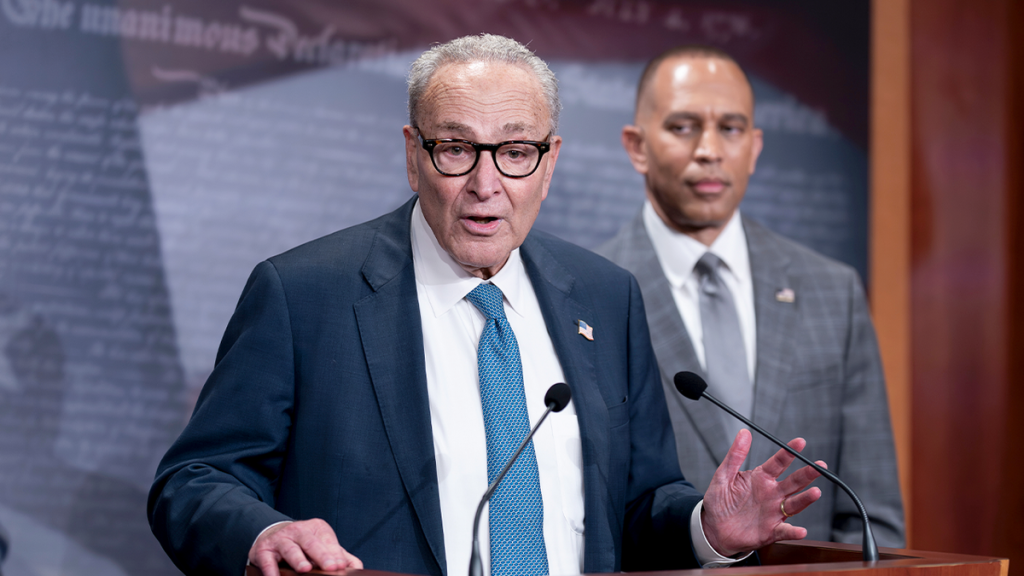
House Minority Leader Hakeem Jeffries, D-N.Y., argued during a press conference that this iteration of the SAVE Act — with its new name — is ‘worse’ than the version that passed the House in April because it gave DHS access to Americans’ voter data.
He appeared to be referring to a provision that would allow DHS to begin potential deportation proceedings against a noncitizen found on a state’s voter rolls.
‘This version, as I understand it, would actually give DHS the power to get voting records from states across the country,’ Jeffries said earlier in February. ‘Why would these extremists think that’s a good idea? That we as Democrats are going to accept at this moment in time? We’d want DHS and ICE, who have been brutally, viciously and violently targeting everyday Americans, to have more data about the American people? It’s outrageous.’
Rep. Chip Roy, R-Texas, who led both the SAVE Act and SAVE America Act in the House, argued Democrats were ‘really reaching’ for criticism.
‘This actually allows and empowers states to be able to — as many of them want to do — check their voter rolls against the citizenship database that they’re currently prohibited from doing under a judicial interpretation of federal law,’ Roy said.
‘So, long-winded way of saying, no — the SAVE system exists, we have citizenship data, and we’re simply going to allow the checking of voter rolls against citizenship data.’
Claim: Suppresses married women’s right to vote
Another oft-repeated argument by Democrats is that the legislation would make it harder for American women to vote — specifically married women whose last names are now different from those on their birth certificates.
That’s because the bill would require proof of citizenship, like a birth certificate or a Real ID, to register to vote.
‘Republicans aren’t truly afraid of noncitizens voting, which we all know is already illegal, already grounds for deportation,’ House Minority Whip Katherine Clark, D-Mass., said earlier this month. ‘They’re afraid of women voting.’
Rep. Emilia Sykes, D-Ohio, said during the same press conference, ‘If your current name does not exactly fit and match the name on your birth certificate or citizenship papers, you could be blocked from registering to vote, even if you are a lifelong naturalized or American-born citizen.’
But Roy again said this was untrue.
‘This is absolute nonsense, and we specifically allow for a provision to make sure that no one can possibly be left behind,’ he said.
‘If a woman tried to register to vote with different names on her birth certificate and driver’s license,’ Roy said. ‘We literally put in the statute that all you have to do is sign an affidavit under penalty of perjury that, ‘I am that person. This is my birth certificate … and this is my driver’s license that is reflecting my married name.’’