Like Simone Biles, Winter Olympians can experience ‘twisties,’ too
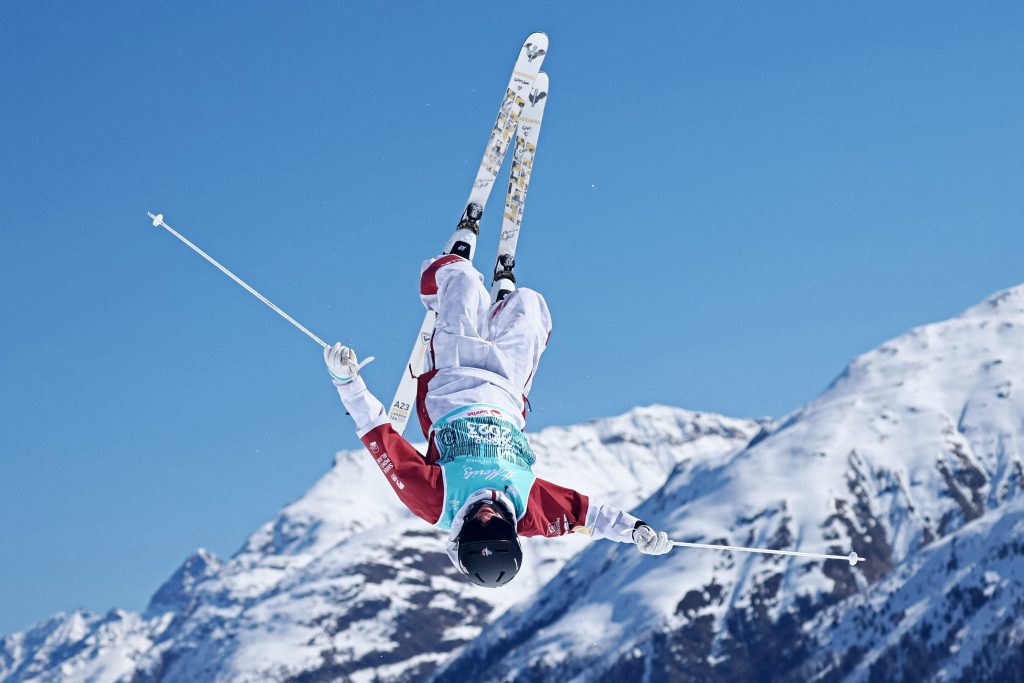
- The ‘twisties,’ a mental block causing athletes to lose their sense of direction in the air, can affect Winter Olympians as well as gymnasts like Simone Biles.
- Winter athletes, including skiers and snowboarders, describe the phenomenon as a dangerous loss of spatial awareness during complex aerial maneuvers.
- Athletes rely on extensive practice and an ‘internal clock’ to execute tricks, but the mental block can still occur despite their training.
LIVIGNO, Italy — Five years ago, Simone Biles introduced the world to a term many outside of gymnastics were unfamiliar with: twisties.
Biles’ mental-health struggles leading to the Tokyo Summer Olympics manifested in being unable to keep track of where she was in the air while pulling off massive flips and turns, a dangerous situation for an athlete flying above the ground.
Turns out, the twisties can affect Winter Olympians, too.
‘I don’t quite do the maneuvers that Simone does, but that same thing can happen,’ moguls and aerials free skier Jaelin Kauf said. ‘Our sport is so mental. There’s so much that goes into trying to be on your game mentally as best as you can.’
Kauf, a silver-medalist at the 2022 Winter Olympics in China, said that she does not practice her tricks on a trampoline much anymore. Two summers ago, every time she tried to do an off-axis trick on the trampoline it resulted in vertigo. She had no idea where she was. All she could do was hope to make it to the inflated landing bed in a safe position.
That summer training is essential to create and become comfortable landing tricks, though. That way, Kauf said, when athletes bring the tricks to snow, they are confident and typically have a 90% chance of landing it. That doesn’t mean the nerves evaporate while standing in the starting gate.
‘We’re so confident we’re going to be able to land and execute them, at least get (the skis) around to our feet if we have to,’ Kauf said. ‘We spend so much time on the air awareness and being comfortable flipping around.’
Chloe Kim, a two-time champion in the women’s snowboard halfpipe, said the idea of experiencing the twisties had never crossed her mind for the majority of her career.
‘You know what’s so funny? No. But then, recently, I started feeling it,’ she told USA TODAY Sports. ‘I think it does happen. At the end of the day, probably not to the extent that gymnasts feel it because they’re doing the craziest things. I can’t even fathom how they’re able to do what they do. It’s insane to me.”
One condition gymnasts don’t have to consider, compared to most winter athletes, is the weather. Cloudier days are tougher than ‘bluebird’ ones because the snow and sky can meld into one visual, Kim said.
‘There are times where you could get completely lost and think that the sky is the snow and vice versa,’ Kim said. ‘So, accidents do happen. You do get lost in tricks sometimes. I’m fortunate enough to not have dealt with it to an extreme level but, yeah.”
Snowboarder Alessandro Barbieri, part of the men’s halfpipe team, said it requires many hours of practice to feel confident while soaring above a ledge.
‘I feel like we all have an internal clock in our mind,’ he told USA TODAY Sports. ‘We have, I don’t know, a second-and-a-half of airtime. So we know to get it done by then. When you’re doing all of these flips, you’re not really looking somewhere except where you’re landing. It’s all feel, like an internal clock or compass.’
Although the ‘twisties’ is not a diagnosed medical term, it is obviously serious for high-performance athletes. In a social-media post at the time she battled the ‘twisties,’ Biles wrote that she ‘literally can not tell up from down.”
‘It’s the craziest feeling ever,’ she wrote. ‘Not having an inch of control over your body. What’s even scarier is since I have no idea where I am in the air I also have NO idea how I’m going to land. Or what I’m going to land on.’
“After the performance I did, I just didn’t want to go on,’ Biles added. “I have to focus on my mental health. I just think mental health is more prevalent in sports right now. We have to protect our minds and our bodies and not just go out and do what the world wants us to do. I don’t trust myself as much anymore.”