Japan leapfrogs top group for pairs gold, like 2002 Sarah Hughes
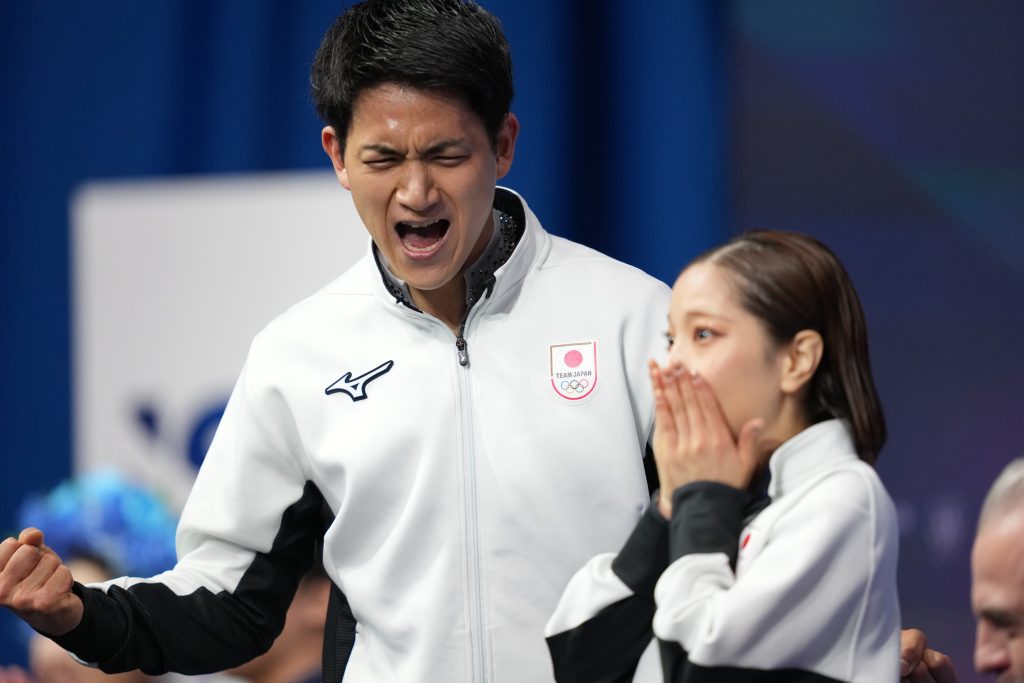
MILAN — They were mired in fifth place, seemingly out of the medals and devastated after making a crucial error on a lift in the short program of the Olympic pairs competition. That’s how the two-time world champion Japanese pair team of Riku Miura and Ryuichi Kihara entered Monday night’s long program.
Then they won it.
Skating 40 minutes before the final pair, they performed a scintillating and flawless long program, then sat rinkside and watched each team ahead of them stumble, making them the Olympic gold medalists. Surprise!
Their victory was sealed when the final pair of the evening, the short program leaders, Minerva Fabienne Hase and Nikita Volodin of Germany, made a couple of errors on jumps.
The score wasn’t even close. The Japanese made up the nearly seven points they were behind the Germans — and so much more. They finished with 231.24 points, nearly 10 points ahead of the second-place pair team from Georgia (221.75) and more than 12 points ahead of the Germans (219.09).
This kind of surprise ending happens now and then in figure skating when a team or singles skater not in the top three leap frogs others to win the gold. They often skate with little pressure as the tension builds for their competitors coming behind them. One famous case of just such a scenario was American Sarah Hughes’ victory over Irina Slutskaia of Russia (silver) and Michelle Kwan of the United States (bronze) at the 2002 Salt Lake City Olympics, considered shocking at the time.
When this happens, the range of emotions from one day to the next is remarkable. On Sunday night after the short program, the Japanese were disconsolate, with Kihara burying his face in his hands, unable to look at their scores.
Little more than 24 hours later, he had fallen to his knees, and she with him, as they hugged and cried in joy, the unlikely but worthy winners of the Olympic gold medal.