How Winter Olympics activities can help your kids with their sports
They bring out personalities with whom we identify and bring us inspiration: The 40-something moms who bobsled and hope they packed enough diapers, the little girl who lost her leg to cancer but has learned to excel on the mountain.
They show us athletic events we don’t always see in our lives, and give us fresh ideas to try.
“There’s well over 50 (events) in the Winter and Summer Olympics,” says Dustin Williams, the assistant director of Olympic sports medicine and the head athletic trainer for track and cross country at Brigham Young University. “My advice is don’t be afraid to try something new because you never know if that’s going to be what you fall into.
‘There’s so many opportunities. Different athletes always talk about how they’re doing well at this event or sport because of their background. Many athletes that I’ve worked with, especially (at) bobsled and skeleton, talk about how it was their track and field background that’s now helped them to excel.”
Williams was speaking at a virtual media briefing hosted by the National Athletic Trainers’ Association last fall. The intent was to try to emphasize a diversity of activities for youth athletes to stimulate overall health and prevent injuries.
Winter Olympic-style activities are an excellent way to change up your routine and take a break from our primary sport before spring season begins. Modifying the events we watch on TV can help kids develop motor skills, control their bodies and build confidence through movement.
We don’t have to hit the bobsled track or find a steep mountain. Here are five easier suggestions:
Indoor curling
Our own Chris Bumbaca tried it before he left to cover the Games in Italy:
During the session with Chris Plys, a Team USA bronze medalist at curling at the 2022 Games, Bumbaca noted not only how much harder the sport was than it looked, but the workout he was getting.
One family found a creative way to tilt curling more toward precision and general movement than speed with mops, water bottles and a target that can be taped to the floor. (This activity could also change up the way you practice your golf putts.)
If you want more strength work, roll a medicine ball toward your target and skip the broom portion or, as one physical education teacher found, you can try “Plank Curling” to work your core and abdominal strength:
Modified speed skating and skiing
Several YouTube channels have come up with entire Winter Olympics units. Front Range Physical Education does alpine skiing in a gymnasium using pool noodles for poles and old scarves for skis.
It’s more of a cross-country activity that tests coordination and gets kids moving:
You can compete at speed skating indoors in similar fashion with carpet squares or paper plates for skates and a circle of cones for the track. The skating motion works familiar kid (and parent) muscles in a different way:
Bobsled and luge with mats and rope
Bobsledding can be mimicked by pushing floor (gymnastics) mats on top of rectangular scooters through checkpoints designated by cones. The idea is controlled strength as kids work their legs and push.
The floor scooters can work by themselves for younger kids and, as they get older, one or two can sit on the mat while the others push:
If you want more strength training, and have a smaller space, tie an end of a rope to something sturdy (basketball hoop, pull-up bar, bleachers) and attach scooters together (like with indoor bobsled). Have kids or adults lie down on them and pull the untied end of the rope to move themselves forward:
Wear a bicyle helmet for safety.
Floor hockey
I never played ice hockey as a kid, but I lived for floor hockey. It seemed to be an equalizer, like Pickleball, for different levels of skill. While pickleball neutralizes the strength and speed elements of tennis, floor hockey takes away the advantage of superior skating.
Floor hockey tests your fitness and physical dexterity and competitiveness. Like with youth ice hockey, you can adapt the game to large or small spaces.
Backyard Olympics
Several years ago, my family spent a weekend at a resort in Pennsylvania that hosted its own Winter Olympics. It was adults and kids mixed together, with teams balanced for strength, size and speed, and it contained events such as tubing, tug-of-war and running through the snow in boots.
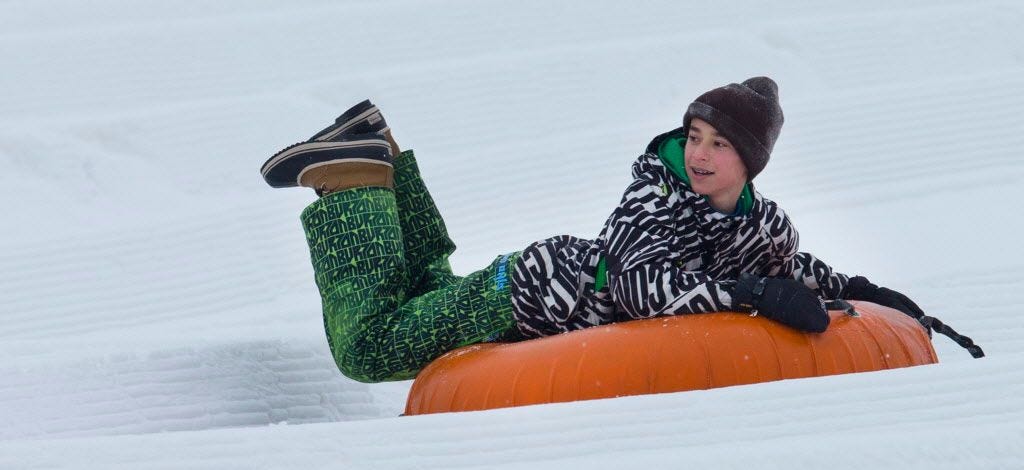
While some of the adults made a big deal about their teams winning (go figure), the idea was we can always create our own games with our ideas. Find a safe, snowy hill and glide down it on a sled or a tube. Make it a biathlon by getting up, picking up a nerf gun and shooting at targets on a tree.
Michele LaBotz, a sports medicine physician and the medical director of the athletic training program at the University of New England, says the best opportunity to develop kids’ basic movement skills is preschool and early grade school.
A variety of activities, even if they’re not formal sports, help them with control of their bodies, such as backward, forward, upside down, in-the-air and balancing motion. This can all be done running around the playground.
If you’re at the slopes, doing similar motions can fill you with hope. Brenna Huckaby, who lost her leg to cancer but became a future Paralympic snowboarder and swimsuit model, got her inspiration on a rehabilitative trip to Utah.
“The idea was, if we could ski down a mountain, then when we got home, we were able to conquer everyday life things,’ she told USA TODAY Sports last month.
Borelli, aka Coach Steve, has been an editor and writer with USA TODAY since 1999. He spent 10 years coaching his two sons’ baseball and basketball teams. He and his wife, Colleen, are now sports parents for two high schoolers. His Coach Steve column is posted weekly. For his past columns, click here.