Braves star’s Hall of Fame candidacy hinges on peak vs. valley
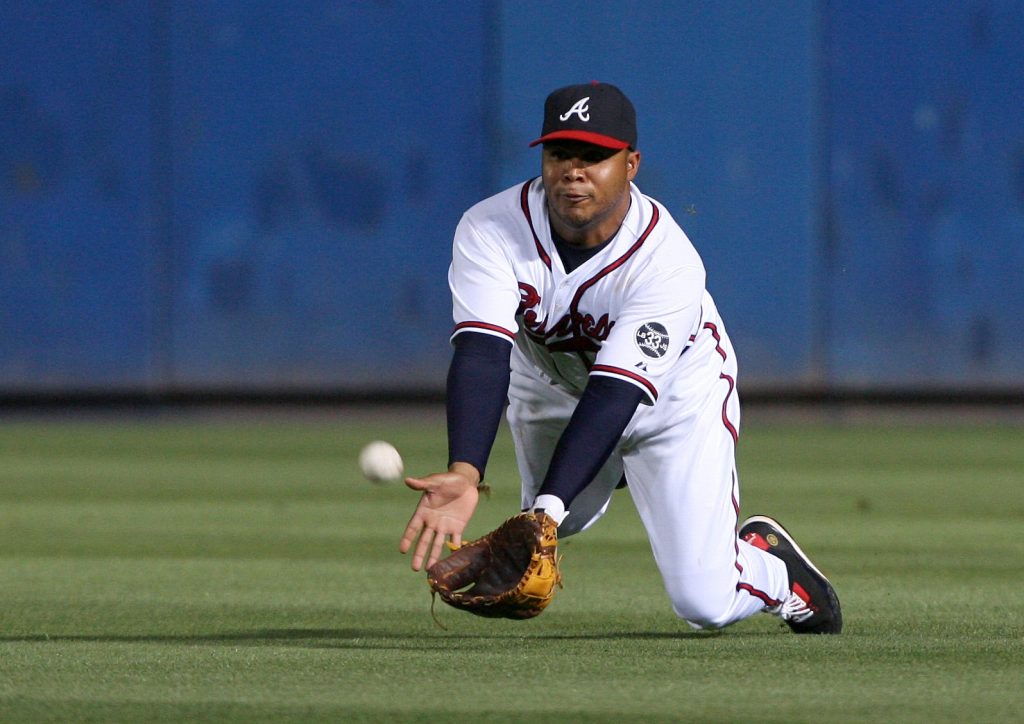
The curious case of Andruw Jones and baseball’s Hall of Fame is nearing a conclusion – a 10-time Gold Glover and 434-homer candidate whose candidacy produces almost as many questions as it answers.
Chief among them: Should a player be penalized for falling so steeply off a cliff at so tender an age?
Jones joined the Atlanta Braves one year after they won the 1995 World Series, famously hitting two home runs in a Fall Classic game as a 19-year-old in 1996, yet never did win a championship.
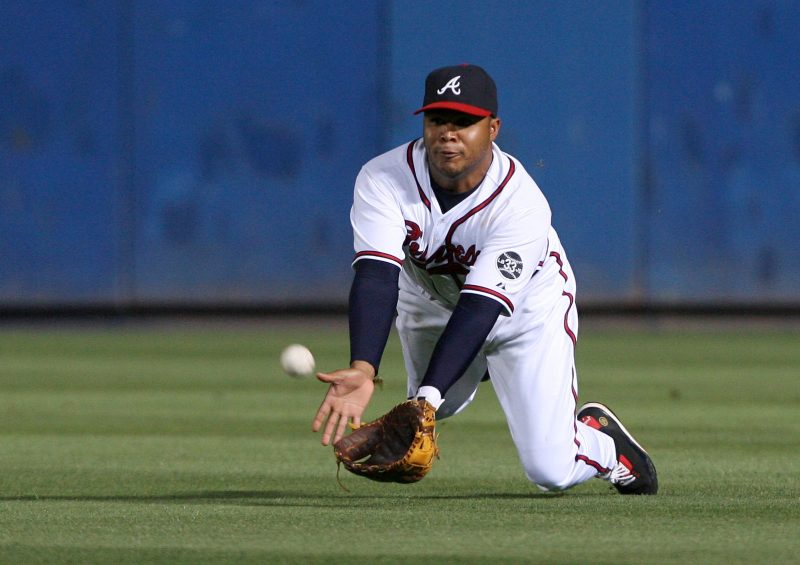
What he did do was provide elite work in center field – his range giving him the ability to play so shallow that he could cut off bloop hits yet also scamper back for balls over his head – and, at times, elite power.
Yet the offensive era in which he posted the vast majority of those numbers was unprecedented, creating a challenge to properly contextualize his counting statistics. And at the point in his career when he figured to be coasting toward a noble finish, leaving no doubt about his Cooperstown candidacy, he simply vanished.
Now, Jones is in his ninth year of eligibility on the ballot, with just one remaining after 2026. And while his window is closing, the gap is narrowing among voters who value his peak vs. those who’d assign him a grade of Incomplete.
Andruw Jones statistics: A mixed bag
For a variety of factors – the game’s metamorphosis, a wider array of metrics, and perhaps most notably the steroid era through which Jones played – the statistical plateaus that all but ensured Hall election have been muddied.
And Jones finds himself on the fence in almost all of them.
What does 434 home runs get you these days? Well, as a center fielder it should get you to Cooperstown. Mickey Mantle and Willie Mays – with 536 and 660 homers, respectively – are the only center fielders enshrined who have more longballs as primary center fielders than Jones.
Carlos Beltrán, a superior all-around player than Jones, has one more homer than Jones. He should earn election in this, his fourth year on the ballot.
Yet as a player in the 2000s and beyond, 434 is a crowded neighborhood. On one hand, Jones is even with Juan Gonzalez, a briefly great hitter whose injuries and PED connections crimped his legacy. In another light, 434 is simply “10 more than Edwin Encarnacion, and five fewer than Paul Konerko,” to name a pair of fellows who didn’t come close to Cooperstown.
A far less scientific distinction – Gold Gloves – is kinder to Jones. His 10 Gold Gloves are tied for seventh all-time, with Hall of Famers Ken Griffey Jr., Al Kaline, Mike Schmidt, Roberto Alomar, Johnny Bench and Ichiro Suzuki, along with modern marvel Nolan Arenado, who will have his own interesting case study someday. Anyone with more than 10 save for first baseman Keith Hernandez and shortstop Omar Vizquel is a Hall of Famer.
Pretty good company. So, it’d seem modern metrics might make this a slam-dunk case, right?
Well.
Jones’ 62.7 career WAR – as measured by Baseball-Reference – again puts him in a gray area, albeit one with precedent on his side. Of the 164 major leaguers who out-WAR Jones, 128 – or 78% – are in the Hall of Fame. Factor in the 18 active players, those not yet eligible for Hall election, players significantly tied to PED abuse or named Pete Rose, and that number goes up to 87.6%.
Not unlike his home run total, Jones’ WAR rent district is replete both with all-time greats, borderline cases and more ordinary players. Yogi Berra (59.5), Mike Piazza (59.6) and Suzuki (60) are among those he’s already passed.
Yet he also trails a large trove of players who more or less epitomize the Hall of Really Good – think Willie Randolph (65.9), Buddy Bell (66.3), Dwight Evans (67.2) and Graig Nettles (68). Detroit Tigers infielder Lou Whitaker, still snubbed by the various veterans’ committees, amassed 75 WAR.
Such ambiguity only makes Jones’ final years more agitating.
Baseball life ends after 30
But goodness, what a beginning. When Jones became the youngest player to homer in a World Series – doing it twice in Game 1 against the Yankees in 1996 – New York’s back pages heralded his arrival in apocalyptic text: HURRICANE ANDRUW.
He needed just one full season to find his footing and by 1998, settled into the great player he’d become: His first Gold Glove, first 30-homer season, an 8.2 WAR campaign driven largely by his defense in the year of Big Mac and Sosa.
Quite a run it was from ’98 through 2005, when his average season looked like this: 30 homers, an .856 OPS, 6.1 WAR, Gold Gloves in every one of those seasons.
It crested in 2005, when Jones hit a career-high 51 home runs and finished second in NL MVP voting, a performance all the more anomalous given that Major League Baseball instituted PED testing with penalties that season, and the Great Shriveling of the game commenced.
They’d ban amphetamines a year later and the game’s offensive numbers began crating further. The balance continued drifting toward the guys on the mound, to the point that 2010 and 2011 both were deemed the year of the pitcher, as if it were 1968 and Bob Gibson was chucking the ball off a mound higher than a Ferris wheel’s apex.
A year later, Jones would be out of the game altogether, his production withering in this new environment. His final All-Star season would come in 2006, a 41-homer, 5.6 WAR season at age 29.
He’d win his final Gold Glove in 2007, though the offensive withering began: A .222/.311/.413 season, with 26 home runs, his last year in Atlanta.
Jones would bottom out at age 31 in 2008, signing with the Los Angeles Dodgers, batting .158 with three homers and, startingly, redlining in WAR, at -1.6. He was booed in L.A., required knee surgery, and the club would eat the $22.1 million owed him in 2009, releasing him while agreeing to pay it out over the next six years.
Jones would eventually retire with a 111 adjusted OPS, or just 11% higher than a league-average player. That was a stat that wildly fluctuated – between 114 and 137 – during his 1998-2006 peak, befitting the Wild West offensive environment of those days.
There are precious few Hall of Famers with adjusted OPSes that low, with Jones’ best comp likely Richie Ashburn, the Phillies legend with the same 111 adjusted OPS yet with 600 more hits than Jones and far more black ink on his baseball card – a two-time batting champ who four times led the NL in OBP.
No, an OPS in the 111 range typically only gets you to Cooperstown – especially on the writers’ vote – with more anomalous achievements. Like Cal Ripken (112), Suzuki (107) or Pudge Rodriguez (106).
Does Jones belong with those guys? Again, this is difficult.
On the fence, until the end
Yet Jones still has a shot. He’s made strong gains on Ryan Thibodaux’s Hall of Fame ballot tracker, clocking 84.2% of ballots, including gains from 11 returning voters.
If 2026 tracks with past years, the integration of non-public ballots will make Jones’ outcome tantalizingly close. A 10th-year boost could be the thing that puts him over the top.
Ultimately, his case may come down to just a handful of ballots. And that’s probably an appropriate fate, given the two phases of an overall fantastic career.